Are You a Data-Intensive Organization? The Storage Strategy the HDD Shortage Is Forcing You to Make
Read More
Insights
No “Business Source License” restrictions. GPL-3.0 means you can build, deploy, and profit freely. Your code, your infrastructure, your rules.
Battle-tested in production at petabyte scale. Enterprise features: erasure coding, uRaft HA, CoW snapshots, SMB, S3, NFSv4 ACLs — all included in the open-source core.
No business source restrictions. Commercial-ready under GPL-3.0. Fork it, ship it, profit from it.
Seamlessly integrates with Linux and Windows environments. Standard filesystem semantics.
Petabytes to exabytes with zero downtime. Chunk-based architecture inspired by Google File System.
Native Proxmox plugin and Kubernetes Operator with CSI driver for seamless orchestration.
Apt-repo, Docker Hub (multi-arch), and RPM. Built for Debian, Ubuntu, and Fedora.
Direct engineering communication. No fluff. Just high-performance storage. Join Matrix and talk to the developers.
Leil FS is a distributed POSIX file system inspired by the Google File System, comprising Metadata Servers (Master, Shadows, Metaloggers), Data Servers (Chunkservers), and Clients (supporting multiple operating systems and NFS). It employs a chunk-based storage architecture, segmenting files into 64 MiB chunks subdivided into 64 KiB blocks, each with 4 bytes of CRC (Cyclic Redundancy Check) for data integrity.
NFSv3/NFSv4 (Ganesha FSAL) · Samba · S3 (Versity gateway) · Native LeilFS POSIX client for Linux.
NFSv4 + POSIX ACLs · Granular quotas (user/group/directory) · Async recursive deletion · Automatic rebalancing · HDD/SSD tiering.
Prometheus-native storage exporter. Kubernetes-ready with CSI driver and Operator. Automated disk management.
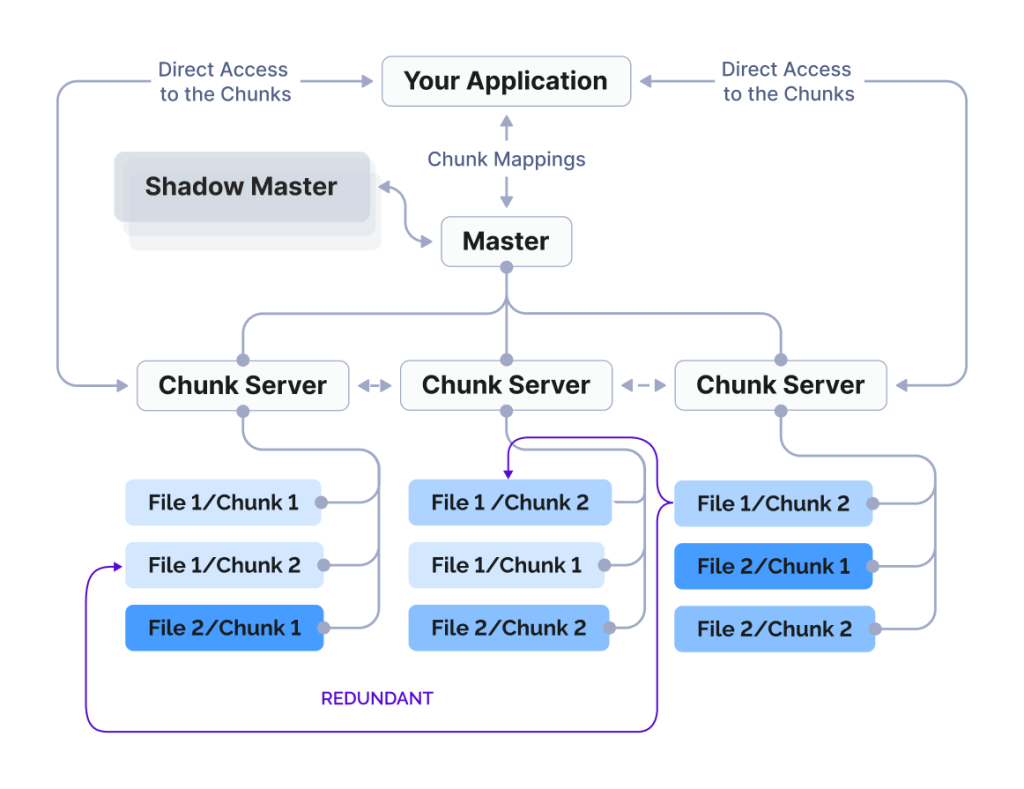
Leil FS™ eliminates legacy performance bottlenecks by utilizing a Parallel HDD-Native™ Architecture that fundamentally separates data and metadata paths. This decoupled approach allows the client to communicate with the Master for metadata operations while simultaneously interacting with Chunkservers in parallel for raw I/O. By performing Erasure Coding (EC) directly within the client-side process, data is protected the moment it leaves the host, distributing the computational “cost” across your entire network of clients rather than taxing the storage tier. For any individual client, the CPU resources required for EC are a tiny fraction of its total capacity, preventing storage servers from becoming a bottleneck even in dense configurations with 100+ drives per node.
Chunkservers focus exclusively on I/O, not computation. Lower CPU requirements per node mean more cost-effective, specialized infrastructure.
Reduced hardware specifications at the storage tier translate directly to lower procurement and operational costs.
Adding storage capacity no longer adds proportional compute overhead; the architecture scales linearly to meet exabyte-scale demands.
While most softwares do not support SMRs, Leil OS brings hyperscale-level efficiency to on-premise environments—unlocking the industry’s most widely deployed, high-capacity, and efficient drives for broader adoption. Our advanced file system handles HM-SMR write management natively, with no firmware hacks, no performance penalties, and no forked software stacks. LEIL OS includes every core feature of LEIL FS — plus the enterprise capabilities you need at exabyte scale.
| Feature | Leil FS The engine of open hyperscale storage Open source · GPL-3.0 | Leil OS Enterprise storage, hyperscale efficiency Enterprise |
|---|---|---|
| Scale and architecture | ||
| Distributed POSIX file system, separated metadata and data planes | ✓ | ✓ |
| Validated scale | Petabyte | Exabyte-class |
| High availability (uRaft failover, floating IP) | ✓ | ✓ |
| Seamless hardware refresh and zero-downtime expansion | ✓ | ✓ |
| Variable capacity support | ✓ | ✓ |
| Data protection | ||
| Reed-Solomon erasure coding up to EC(32,32) | ✓ | ✓ |
| Replication with label-based tiering (SSD/HDD/NVMe) | ✓ | ✓ |
| Copy-on-write snapshots, trash, CRC scrubbing | ✓ | ✓ |
| Automatic data rebalancing | ✓ | ✓ |
| Double-level erasure coding (cross-rack + local) | — | ✓ |
| Extra local erasure coding for fast per-node rebuilds | — | ✓ |
| Protocols and clients | ||
| Native POSIX client (Linux, FUSE3) | ✓ | ✓ |
| NFS v3/v4 (Ganesha FSAL) | ✓ | ✓ |
| S3 (Versity gateway) | ✓ | ✓ |
| SMB/CIFS | Single-node Samba | Clustered Samba |
| Windows client | — | ✓ |
| Windows management console | — | ✓ |
| Flexible mounting modes (user- or system-level) | — | ✓ |
| Security and governance | ||
| POSIX and NFSv4/Rich ACLs, byte-range locking | ✓ | ✓ |
| TLS on all component links | ✓ | ✓ |
| Quotas per user, group, and directory (size and inodes) | ✓ | ✓ |
| Fast recursive deletion (async task manager) | ✓ | ✓ |
| HDD-native hardware support | ||
| CMR HDD, SSD, NVMe | ✓ | ✓ |
| Host-managed SMR drives (production write path) | — | ✓ |
| Mixed drive generations in one cluster (CMR + SMR) | — | ✓ |
| ICE — Infinite Cold Engine (up to 70% energy savings) | — | ✓ |
| Head depopulation (extended drive lifespan) | — | ✓ |
| Command duration limits (CDL) for QoS | — | ✓ |
| Hardware top performance pack | — | ✓ |
| Operations and data services | ||
| Web UI, Prometheus metrics, admin CLI | ✓ | ✓ |
| Leil Connect — multi-site federation | — | ✓ |
| Leil Navigator — cluster-wide data exploration | — | ✓ |
| Support and services | ||
| Support model | Community (Matrix) | Enterprise support |
| Pre-validated reference architecture | — | ✓ |
Free to deploy and modify · community support
Enterprise support · pre-validated reference architecture
All Leil FS capabilities ship inside Leil OS — same engine, same APIs, same protocols.
Leil FS is a truly open-source distributed file system licensed under GPL-3.0. It is the successor of SaunaFS and implements concepts introduced by Google FS. Leil FS is commercially ready, battle-tested at petabyte scale, and includes enterprise features in the open-source core.
Leil FS uses the GPL-3.0 license – not a Business Source License. This means you can build, deploy, and profit freely with no restrictions. Fork it, ship it, and retain full control of your infrastructure and code.
Leil FS includes erasure coding, uRaft high availability, copy-on-write snapshots, NFS/SMB/S3 protocol support, NFSv4 + POSIX ACLs, granular quotas, automatic rebalancing, SSD and CMR HDD tiering, periodic scrubbing, and Kubernetes orchestration with CSI driver.
Leil FS is the free, open-source foundation that supports SSD and CMR HDDs. Leil OS adds Host-Managed SMR support, ICE power-disable, Head Depopulation, advanced erasure coding, Windows console, and the hardware performance package — features needed for mission-critical enterprise deployments.
Leil FS performs erasure coding directly within the client-side process, distributing the computational cost across your entire network of clients rather than taxing the storage tier. By performing erasure coding on the client rather than the storage server, Leil FS keeps chunkservers focused exclusively on I/O. This decoupled architecture enables leaner storage servers, reduced hardware costs and linear scalability to exabyte scale without compute bottlenecks.
Leil FS is available via apt-repo (Debian, Ubuntu), RPM (Fedora), and Docker Hub (multi-arch). It includes native Proxmox plugin and Kubernetes Operator with CSI driver for container orchestration. POSIX compliant for Linux and Windows environments.
Yes. Leil FS is battle-tested in production at petabyte scale. It is a commercially-ready, open-source parallel file system with the full protocol stack (NFS, Samba, S3, native POSIX) and enterprise resilience features included in the core distribution.
Yes. Leil FS is GPL-3.0 licensed with no Business Source restrictions. All core features – erasure coding, high availability, snapshots, multi-protocol support – are included free. Deploy at petabyte scale with no licensing fees or hidden obligations.
Seamless. Leil FS and Leil OS share the same architecture and codebase. When you need HM-SMR support, ICE power management, or Head Depopulation, you upgrade to Leil OS with no data migration and no re-architecture required.
Yes. Leil FS includes a native Kubernetes Operator with CSI driver and a Proxmox plugin. Multi-arch Docker images are available on Docker Hub. The filesystem integrates directly with container orchestration for automated storage provisioning.
Absolutely. Leil FS is enthusiast-friendly with direct engineering communication. Join the Matrix channel to talk directly with the developers. The GPL-3.0 license ensures your contributions remain open and the community benefits.
Native POSIX via the Leil FS client, NFSv3/NFSv4 via Ganesha FSAL, SMB/CIFS via Samba, and S3 via the Versity gateway. Your applications can access storage through whichever protocol fits your workflow – no custom drivers needed.