Are You a Data-Intensive Organization? The Storage Strategy the HDD Shortage Is Forcing You to Make
Read More
Insights
Over half of all HDD capacity is now SMR – a shift hyperscalers have been justifying for over a decade.
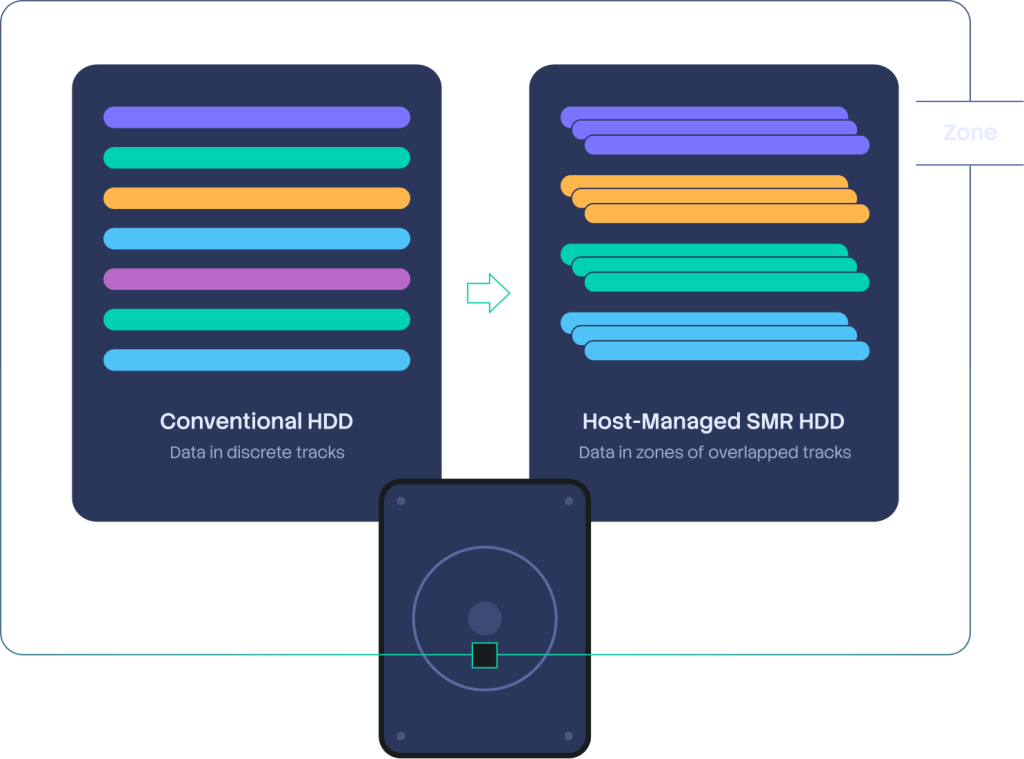
SMR overlaps data tracks like roof shingles, increasing areal density by ~20% on the same platters. Because of the shingled track structure the drive accepts only sequential write workloads.
Host-Managed SMR (HM-SMR) gives the software (host) direct control over sequential write workload. Leil implemented the software stack enabling host managed SMR use at scale: — over mulitple drives and multiple servers in a single namespace, managing drives and taking care of garbage collection.
20%
20%
20%
20%
While most softwares do not support SMRs, Leil OS brings hyperscale-level efficiency to on-premise environments—unlocking the industry’s most widely deployed, high-capacity, and efficient drives for broader adoption. Our advanced file system handles HM-SMR write management natively, with no firmware hacks, no performance penalties, and no forked software stacks.
Yes, with the right software. Leil handles HM-SMR write management natively across multiple drives and servers in a single namespace. No firmware hacks, no performance penalties, and no forked software stacks. You get hyperscaler-grade SMR efficiency on standard enterprise infrastructure.
Approximately +20% usable capacity per drive compared to CMR — that is +6TB free on a single high-capacity disk. At fleet scale, this means petabytes of additional storage from hardware you already own, without any new procurement.
No. Leil manages all SMR-specific complexity – zone management, garbage collection, sequential write orchestration – transparently at the filesystem layer. Your applications see standard POSIX, NFS, SMB, or S3 interfaces with no workflow changes required.
Absolutely. SMR is the same technology that hyperscalers have relied on for over a decade at massive scale. Leil OS is verified with two major HDD vendors and achieves 95%+ efficiency on SMR drives. The technology is production-grade and battle-tested.
SMR drives deliver 20% higher density, 20% lower energy per TB, and the best $/TB cost in the industry — all from the same physical platters. Combined with Leil’s HDD-Native management, you get more capacity at lower operating cost per terabyte.
With proper software support, SMR drives achieve near-CMR performance levels. Leil OS reaches 99% read throughput and ~95% write efficiency on SMR. Without HDD-Native software, SMR drives experience severe write amplification and tail latencies due to random-write patterns being forced onto sequential media.
Yes. Leil enables seamless capacity refresh across drive generations – CMR and SMR coexist in the same cluster without any downtime. You can introduce SMR drives incrementally alongside your existing CMR infrastructure.
SMR drives are wrong for the random workloads. With Leil, SMR runs at near-native throughput – 99.7% read / 95.4% write efficiency on WD Data102 (under 1% read, under 5% write overhead vs the raw drive). Random I/O moved to flash years ago; capacity workloads are sequential, which is exactly where SMR excels. Leil approaches the drive sequentially and sidesteps the IOPS bottleneck. Real numbers: ~14 GB/s from one JBOD, ~16 GB/s sustained per rack, over dual 100GbE, with no flash caching. Don’t let SMR get treated as archive-only – use it as fast HDD capacity.